
Today’s learning at home activities
for Year 5….
Friday 22nd May 2020
As we come to the end of this half term, we would like to wish you
and your families a fantastic break from home school. Hopefully,
you can enjoy spending lots of special time making cherished
memories together. We would like to thank you for supporting our
distance learning during this unique time. Your continued support;
the high standard of work sent in; and our email feedback system
have allowed us to keep in touch with you and your learning whilst
we are unable to be together in the classroom. During these
challenging times, you have continued to demonstrate our special
'Park Gate Way' and this makes us feel extremely privileged to be a
part of a wonderful school which is full of extraordinary young people!

Sending best wishes and good health to you all!

Mr Donnelly 🧔, Mrs Griffiths and all of the Year 5 staff team!

English task: Newspaper Features- Using Effective Headlines

First a headline to make you giggle!
Rangers, your upcoming mission is to write a newspaper report all about the 1969 Apollo-11 Moon landing. To do this you will need a strong headline in your journalist’s tool kit!
Use the following PowerPoint slides to consider the purpose of a newspaper headline.
Next, pick from * (Red) task, ** (Yellow) task or *** (Green) task difficulty.
In * red task you must match the headline to the news story.
In ** yellow task you must match the headline to the news story and then pick the correct justification for why this is an effective headline.
In ***green task you must match the headline to the news story and then write your own justification for why this is an effective headline.
Task: Headline Match Up Cards All Groups
Finally you must think of a great headline for your own Apollo 11 Moon landing newspaper report. Will your own headline use alliteration? a pun? short snappy sentences? or maybe included some shocking or strange information? to attract the attention of the readers.
Maths task: Mental Maths Missing Value Puzzle Cards
A little Friday challenge for you all. Can you solve these space themed maths picture puzzles?
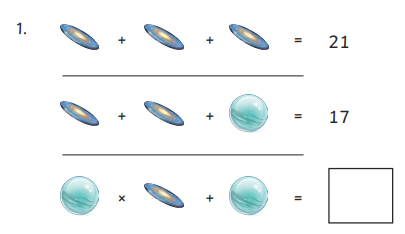
If I know that 3 x SPACESHIP = 21
I know that…21 ÷ 3 = SPACESHIP
7 x 3 = 21 so each spaceship = 7!
Then I workout SPACESHIP + SPACESHIP + PLANET = 17
7 + 7 + PLANET = 17
so 14 + PLANET = 17
How many more than 14 is 17?
I’ve got it! PLANET = 3!
You will need to use your knowledge of the inverse operation and the challenges may need to be solved in a certain order to make them work. Allow 1 hour to complete as many as you can. There is no need to do them all – unless you want to be extra ‘math-a-magical’ today! I’m not going to lie to you, this type of maths makes me very excited and I couldn’t stop until I’d solved them all!
Thursday 21st May 2020
English task: Exploring the features of a newspaper WAGOLL
First read this newspaper WAGOLL (What A Good One Looks Like!) about Tim Peake’s unfortunate phone call mix up whilst he was in space! Please don’t scroll down to far as the answers are at the bottom of the extract. It should look like this:

Next, read the following slides from a teaching PowerPoint on newspaper features.
Lesson Presentation – Exploring Newspaper Reports
PowerPoint Lesson – Exploring Newspaper Reports PDF
You are going to try to find the following newspaper features. You should neatly show this through using this colour coded key. (If you don’t have the right colours, please don’t worry, just do your best to make them all different!)
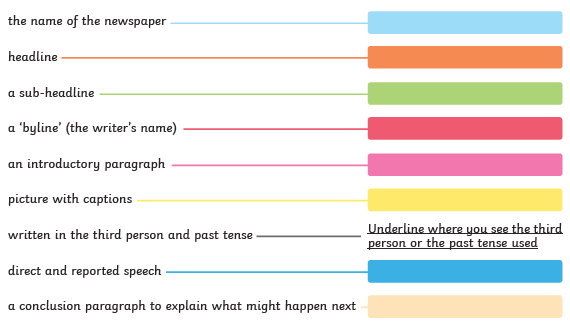
Answers are included at the end of this PDF document.
Please note that we’re not looking for perfect accuracy, just a good explore and try to think about what makes a newspaper, a newspaper!
We are aiming to write our own newspaper reports about the 1969 landings so prepare yourselves to become journalists!
Maths task: Mental Maths Challenge Cards
Today’s maths task is designed to revise and test your mental maths skills!
Pick a colour, calculate and then check please!
(Please note the card colours on the PDF do not match difficulty groups. The links below are the correct card sets for each task by the title)
Mental maths card answers for all groups
Wednesday 20th May 2020

Thank you for sending over all of your superb notes about the Apollo-11 Moon landings! They will be really useful for our upcoming tasks, space rangers!
Today is Wednesday and that means that at midday today, it will be closer to the end of the week than it is to the start of it. That’s something to smile about!
English task: Timeline of the 1969 Apollo Moon Landings
First read the following information about the series of events that took place during this unique mission to the moon! Apollo 11 moon landing timeline notes
Next, use a storyboard style to map out the key events. There are 3 different recording sizes – please pick the one that you feel is best for you. Or alternatively, you can use your own well-thought out method of presentation for this task. Moon Landing Timeline Recording Sheets
Please feel free to sketch some awesome pictures and use words to describe the key events which happened. You could even add cartoon like speech bubbles to each picture if you’d like. Please don’t forget to add the date for each one and they should be in chronological order too!
Maths task: Mental Maths Arithmetic Pairs
Today’s challenge is to match up as many of these questions as you can to their answers using mental estimations. Please email your work to Mr Donnelly (and not Mrs Griffiths) for feedback today. You may not need to perform any written calculations at all but you can if it helps you. Try and think of how estimations could help you to take a ‘best guess.’ Cutting and sticking, colour coding or writing out the questions next to their matching answer are all great ways to present today’s learning.
Green task:

Yellow task:

Red task:

You can print these matching pairs out, if you would like to using this easy PDF link…Wednesday Maths PDF
There are no answers provided today for maths as Mr Donnelly will be checking your maths for your feedback.
Bonne chance la class!
Tuesday 19th May 2020
English task:

Please continue to add to your ‘1969 The Apollo-11 Moon Landing’ research notes for today’s home learning.
Please email a copy of your organised notes to Mr Donnelly (both Sycamore and Juniper classes) for feedback.
I will be looking for a clear organised layout, inclusion of the key facts and the correct spellings of all key vocabulary used.
Maths task:
Today’s maths task is just like yesterday’s except we are going to add near multiples of a 1000 and then adjust rather than subtracting them.
Today’s questions:

A helpful hint should you need it…Tuesday Maths Hint
Today’s answers: Tuesday Maths Answers
Monday 18th May 2020
Happy Monday Year 5! Thank you for coming back after your weekend break! We’re so glad you did!

It was amazing to receive such awesome work last week – you’re all awesome!
This week the English task on Tuesday and the maths task on Wednesday should be emailed to Mr Donnelly (Not Mrs Griffiths this week) for individual feedback please.
English task:
This week’s English is going to focus on the 1969 Moon landings! You are going to need to become very knowledgeable about what happened the day that mankind first stepped on to the surface of the moon. Did you say 1969? But, that’s only 51 years ago! Yes, there are many people who are alive today who will have watched the moon landings live on TV.
Optional challenge for the week: We would like to challenge you to speak to someone who may remember watching the moon landing live in 1969 to see what they remember about it? Where did they watch it? What was their TV like? How did the images look? How did they feel before/during/after the event? Make some notes in your learning at home book about this, if you can.
You have both Monday and Tuesday to complete this first research task so that you have lots of time to gather information about the 1969 Moon landing. This will be vital to some of your upcoming tasks, so please make sure you spend lots of time immersing yourself in this historical event. I have included links to video clips and fact pages as well as a a PowerPoint (As a PDF) to help you. Please don’t think this is all you can use though, you are welcome to complete research of your own to add extra detail in, but please remember to always search the internet in a ‘SMART’ way.
Apollo 11 Moon Landing PowerPoint
Apollo 11 – Newsround Information Page (with game link!)
Neil Armstrong – A BBC Learning Clip
In your home learning book add a main heading – ‘The 1969 Apollo-11 Moon Landing.’
Next, divide your page into sections and try to fit your notes as best you can under these subheadings…
- Who?
- What?
- When?
- Why?
- Where?
- How?
- Other interesting facts
Moon Landing Research Note Page – In this link there is an example of a planning format which you could use to help you to organise your information. It is really important that you write everything in your own words and do not copy anything that you don’t understand into your research notes. How you layout your notes is up to you- but it must be clear and organised into sections please.
Maths task:
In maths this week we are going to practise some of our mental methods of calculation.
These methods have been taught in school, so for many of you this will be a chance to remember and practise your methods.
Method 1 – Monday – Subtracting with rounding to a near 1000 and adjusting
You can watch these two examples first in order to recap the method…
Please record each of today’s questions as a number sentence in your learning at home book. Remember this is a chance to practise this speedy method – be patient and keep practising if you need to.
e.g. 1. 3653 – 999 = 3654

A helpful hint should you need it…Monday Maths Hints
Today’s answers: Monday Maths Answers
Friday 15th May

I can’t believe another week of home school has almost gone!
Don’t forget to watch Miss Turner’s awesome dance party this morning live on Facebook!
I feel it’s time for some ‘fun’ Friday jokes to see us into the weekend! I’ve picked a space theme for these! And I think they’re absolutely out of this world!
Q: What kind of plates do they use on Venus?
A: Flying saucers!
Q: When do astronauts eat?
A: At launch time!
Q: How does the barber cut the astronaut’s hair?
A: E-clipse it!
Q: What is an astronauts favourite key on the keyboard?
A: The space bar!
Keep working just as hard today as you have been all week Year 5. You are all amazing, we miss you lots and we hope that you have a wonderful weekend full of family fun!
English task:
Click the PDF below for one final task using Matt Haig’s fabulous ‘To be a cat.’ This time it’s a writing task which will allow you to be a little bit creative!
To be a Cat – Matt Haig – Task 3
Maths task: A pocket money maths challenge…

Spend 45-60 minutes having a go at this Friday Maths Challenge- Year 5 Maths Challenge – Pocket Money
If you feel stuck, and only once you’ve tried, click this for a helpful hint (or spoiler!) – CHALLENGE HINT
Once your finished, you can mark your answers using this PDF – Pocket Money Answers
____________________________________________________
Thursday 14th May
A big THANKYOU for sending over your ‘sweet’ maths work and book selfies. It is so lovely to see a sea of happy, friendly and smiley faces! It also makes me really happy to see the super range of books that we are all reading! Please don’t forget to keep updating your reading record every time you read. Great job – Year 5!
English task: Today you will be focusing on the ‘P’ from reading VIPERS- predictions!
Click the blue link to open extract 2 and today’s task..

To be a Cat – Matt Haig – Task 2
Listen to the extract with the audio file below.
Good luck!
Maths task:
Today’s task is all about choosing the correct mathematical operation. In each of the word problems will you need to multiply or divide to find the answer. Which clues will help you to decide whether to divide or multiply?
Red group please complete questions 1-3 and if you are feeling confident, you can challenge yourself to some yellow questions.
Yellow group please complete questions 1-6.
Green group please complete questions 4-9.
Multiply or Divide? Word problems
Multiply or Divide? Word problem answers
Here are some audio clips of the questions being read out loud.
Green audio:
Yellow audio:
Red audio:
__________________________________________
Wednesday 13th May
Good morning home school! It has been great to receive all of your reading VIPERS work this week, thank you! We hope that the feedback you received was really useful. Yesterday’s ‘Gone Fishing’ tasks seem to have been popular with you at home, and rumours have been heard that it may have even brought out a rather competitive spirit in some households!
I’ve got a challenge for you today! Please can you snap a selfie of you with your reading book and email it to your teacher with today’s maths task. We’d love to see you, and what you are currently reading at home! Here’s my book selfie. Please excuse the emergency lock down haircut! Mrs Donnelly took far too much pleasure from cutting all my hair off!

We can’t wait to see you all- even if it is just a selfie- and sadly not the real you, just yet!
English task:
It’s time to complete some tasks based on a book by one of my favourite authors, Matt Haig.
PDF of task sheet can be downloaded here… To be a Cat – Matt Haig – Task 1
Today will be looking at why authors use direct speech in their stories.
Firstly read the extract from ‘To Be A Cat.’ You can also listen to it being read here…
Next, neatly highlight or neatly underline all of the direct dialogue (speech) in the extract.
Following that, use your highlighted speech quotes to explain how the author, Matt Haig, has either conveyed (shown) character or moved the action on in the story. Try your best to explain how this choice of dialogue has impacted the reader. How does it make them feel? Does it tell the reader important information or does the reader learn something about a character? Maybe the way the words are said shows how the character is feeling about the situation? You have to decide as a reader what do you take from this piece of speech. Try to pick between 3 and 5 examples to add to a table.
Finally, write a short paragraph to explain how the extract made you, as a reader, feel. What emotions did you feel? Did it make you laugh, cry or smile? Did you feel empathy towards the main character? Maybe you felt intrigued to read more of the story? Maybe you want to find out more and have lots of questions about what is happening?
Maths task:
Today’s maths problem should please be emailed, alongside your book selfie, to your class teacher. Thank you!
Today, I have set a ‘sweet’ problem for you to solve.

Please take care to present your work neatly so that your teacher can follow your method. It may help to write a sentence to explain your thinking at different stages during your working out.
A ‘sweet’ problem – Yellow and Green Task
If you find yellow task a little tricky, please don’t be afraid to complete red task today instead.
_________________________________________________
Tuesday 12th May
English task:
Please complete one of the Neil Armstrong reading comprehension tasks. Pick either * (Red), ** (Yellow) or *** (Green). Please mark your own answers once you have completed the questions.
Maths task:
Today, if you can, we would like you to play a game to practise your division skills. There are three different levels. Pick either * (Red), ** (Yellow) or *** (Green). If you can, please play one of the games with someone at home. If you can’t, please don’t worry and just try your best to complete the questions by yourself using bus stop division method.
Gone Fishing Division Games – Red, Yellow and Green
___________________________________________________________
Monday 11th May 2020
Good morning Year 5! We all hope that you enjoyed your 3-day weekend. Did any of your roads have a socially distanced street party to celebrate VE Day, I wonder? Mine didn’t, mainly because I live on a very busy main road, but I did have a lovely time ‘digging for victory’ in the garden with Ava. We planted out some vegetable seeds and marigolds before we enjoyed eating some cake with a cup of tea (and water for Ava) in the glorious sunshine. Later, at 3pm, we toasted the heroes of World War 2.

Thank you for sending in your amazing Tim Peake interviews – it’s clear that you have learnt a lot about what it is like to be an astronaut and many of you have great potential to be either astronauts or reporters in your future careers!
We will be adding some extra enrichment activities this week so make sure you scroll right down to see some of the wonderful tasks that you could choose to complete. So far there is a task for Mrs McCarthy and a space-themed computing Scratch programming challenge for you to try!
Here is an outline for this week’s activities…

English task:
Read the page ‘Years and seasons’ from ‘When will the sun go out’, one of our BugClub books.

You can download here in a larger format: When the sun goes out Text
Carefully answer each of these reading VIPERS questions in your learning at home book. Answers are provided
V – Find the meaning of each of these words (all taken from the text) using a real dictionary, if you can. You may need to use https://www.dictionary.com/ if you don’t have a physical dictionary at home to use. Write down your definitions in your home learning book.
a) orbit b) axis c) ellipse
I – In the UK, which season occurs when our country is tilting towards the sun?
P – Do you think that the planet Jupiter would take more or less than 365 days to orbit The Sun and why?
E – List 3 presentational devices that the author has used to organise this non-fiction page. An example of a presentational device would be a fact box.
R – Find quotes in the text to support your answers to these questions…
- How long does it take for the Earth to orbit the Sun once?
- List 3 things which the author uses to describe how the seasons make it ‘more fun to live on Earth.’
- In just 5 minutes on planet Earth, how far have you travelled through space?
S – Using no more than 25 words, summarise the content of this information text.
ANSWERS are available here. Please can you self mark (really honestly) before sending your work to your class teacher. We will be looking at all of your responses; looking particularly at your summarising skills as this can’t be self-marked at home.
Maths task:
We’re going to keep with a theme of multiplication and division this week so that you can really perfect your methods!
Today’s lesson will use an online Oxford Maths activity to recap short division.
I’ve made a little video to show you how to use the program. Hope it helps you!
Please can you record your answers and the questions in your ‘Learning at Home’ book in order to show your learning.
____________________________________________________________________
Thursday 7th May 2020
It was absolutely fantastic to receive such amazing bus stop division maths work from you all on Tuesday.
Great job, Year 5!

Today is the last day of the week we will be setting English and maths challenges as tomorrow is a bank
holiday. However you choose to celebrate the 75th anniversary of V.E Day, we hope you have a great day,
Please don't forget to raise a toast to the Heroes of World War 2 at 3:00pm.

The official toast for this event is: 'To those who gave so much, we thank you.'

English task:
We are really excited to receive your English work today which will be all about astronaut, Tim Peake!
You have watched, researched and learnt about Tim’s life as an astronaut. Now we would like you to write a 3 part question and answer session with you interviewing Tim Peake.
You should write as if you are the interviewer and you are asking Tim the 3 questions after introducing him in a short summary (which was written for yesterday’s task). It may look at little like this WAGOLL..
Tim Peake Q and A session WAGOLL
We are looking for outstanding presentation, keeping related factual information together in a paragraph and using lots of factual astronaut knowledge in your work. Good luck space rangers, I’m sure you will do us proud!
Maths task:
Today, we would like you select tasks based on how confident you feel with bus stop method and finding both remainders and exact decimal answers.
Red task today is for anyone who would like to practise their fluency of bus stop without any worded problems to make things more complicated. Red task: Division short method practise
Yellow task is full of worded problems which are designed to make you think! Read the questions carefully and be sure to give your answer in the correct way. Some answers will need to rounded up or down, some may need remainders to be given and others will need exact decimal answers. Yellow task: Division worded problems with remainders and decimals
Green task: It’s just like yellow task but it’s much, much, much, more challenging! Only the bravest mathematicians can answer these worded problems correctly! Green group: Division with remainders multi-step word problems
TOP TIP: Act out or draw the worded problems before trying to apply your maths learning to the problems ‘story.’
_______________________________________________________
Wednesday 6th May 2020
English task:
Today you will be writing your very own summary paragraph about British astronaut, Tim Peake!

Use yesterdays sentence openers task as your WAGOLL (What a good one looks like!) This is an example of a summary paragraph but its about Neil Armstrong and not Tim Peake!
Re-read your paragraph about Neil Armstrong. Do you think Mr Donnelly has managed to answer all of the key questions in his WAGOLL summary…? If not can you add anything to improve the paragraph and answer all of the questions below?

You must research and then summarise Tim Peake’s career as an astronaut. Use the checklist below to ensure your work is great!
This will be used as an introduction paragraph for your question and answer session script, which you will be creating tomorrow.
|
Checklist for you summary paragraph |
|
|
Feature |
My Check |
|
3rd person |
|
|
Varied sentence openers |
|
|
Answers these key questions: who, what, why, where, when , how? |
|
Maths task:
Today you are going to learn how to create decimal answers when using bus stop method.
Watch this video explaining how to convert your remainders into decimal answers.
Sometimes it’s great to leave an answer with a remainder – e.g. when counting the number of 4-seated cars which are needed to take a class of 30 on a school trip.
We complete the number sentence 30 ÷ 4 = 7 r2
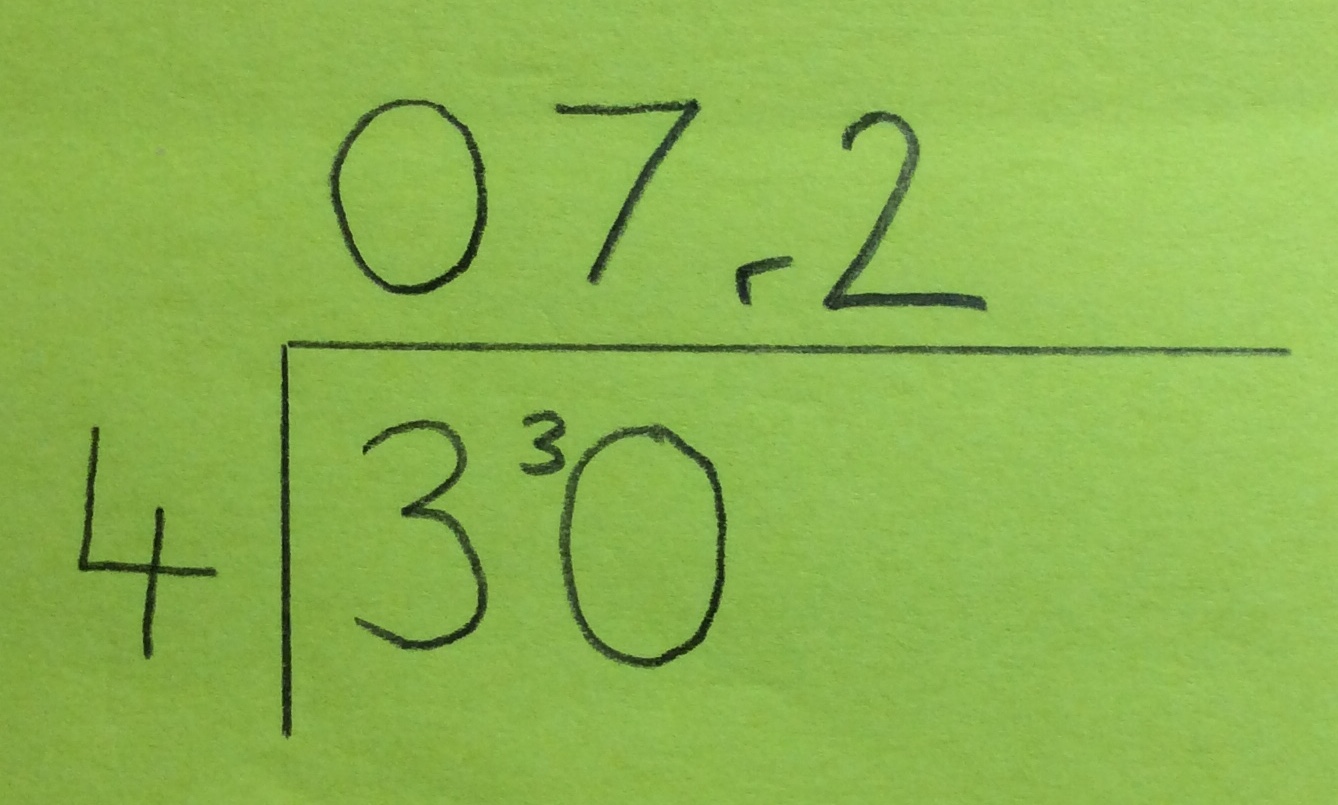
In this case, the answer must be rounded up as a decimal answer is not appropriate here as you cannot have 0.5 of a child to put into a car! Meaning we would need 8 cars to take all the children on the trip as 7 would not be enough cars to take all the children.
Other questions need a decimal answer such as this one:
4 Friends split the bill in a restaurant. If the bill comes to £30.00, how much should they all pay?
30 ÷ 4 = 7.5 or £7.50 each to pay.
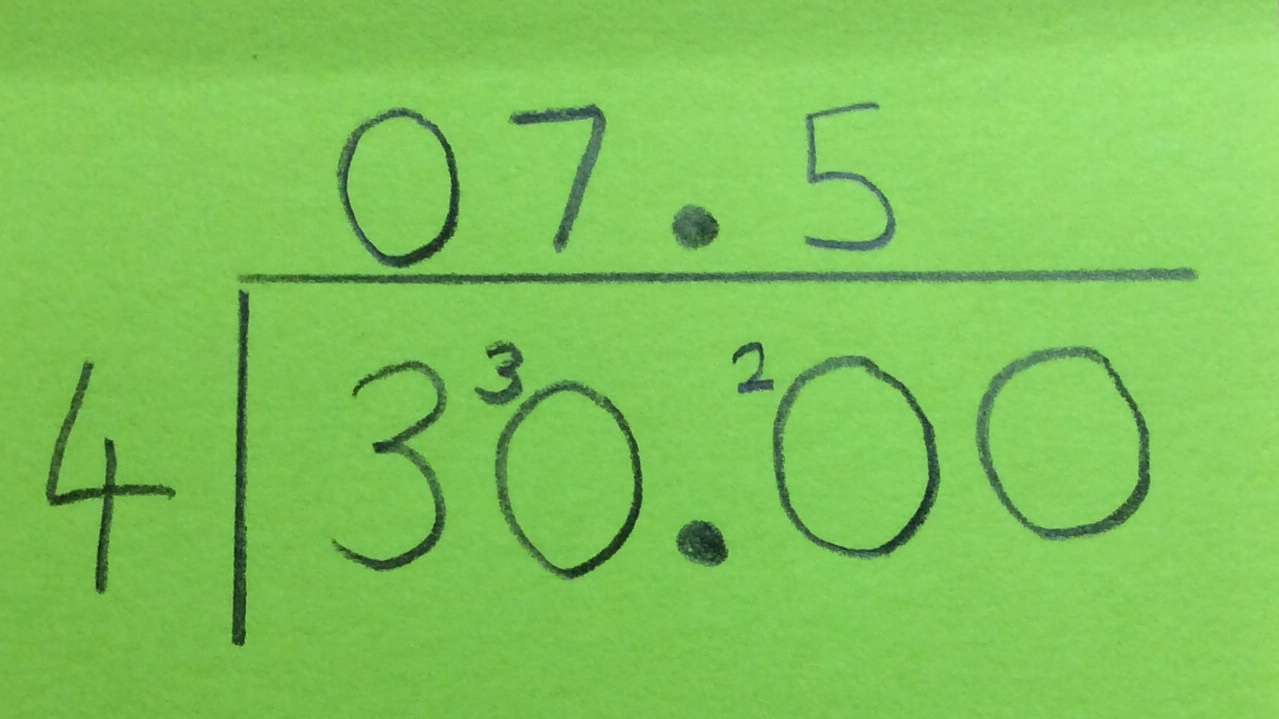
You cannot pay £7.00 each and then have a £2 remainder left to be paid. You will have a very angry restaurant manager running down the street after you! You need to be exact and use decimals. In this case by working out a decimal answer we know each person must pay £7.5 or £7.50 for their meal.
Now it’s your turn…
Divide your page in half and in one column use bus stop method to work out an answer with a remainder. In the other column use bus stop method to work out an answer with decimals. Good Luck, Year 5!
Red: Complete Red Questions 1-6
Yellow: Complete Yellow Questions 1-6
Green: Complete Yellow Questions 1-6 and Green Challenge

__________________________________________________________________
Tuesday 5th May 2020
English task:
Good morning space rangers! It was great to watch Tim Peake talk live on YouTube yesterday all about exercising in space, selecting astronauts and what it’s like to complete a space walk outside the ISS. I hope you learnt some interesting things to add to your research about astronauts. Great effort in trying for a shoutout for the school Cam10- maybe next time?!
Begin today’s task by watching this real video footage of Neil Armstrong’s moon landing in 1969….
Now read the following summary paragraph about Neil Armstrong. Use the sentence openers given to improve the paragraph and stop it from being so repetitive.
Neil Armstrong Summary to Improve
Green challenge: Can you not use the suggested openers and use some of your own ideas instead?
Maths task:
Today’s maths task has been chosen for teacher feedback so please send copies of your work by email to Mr Donnelly or Mrs Griffiths by the end of today.
Today we will be looking at remainders when dividing using bus stop method.
Please note that all questions should have a remainder today – except for green task!
Red: Complete Red Questions 1-6
Yellow: Complete Yellow Questions 1-6
Green: Complete Yellow Questions 1-6 and Green 1-3

Division with remainders Answer Sheet
_____________________________________________________________________________________________________
Monday 4th May 2020 (Stars Wars Day)
Good morning, and May the 4th be with you! We hope you have had a fantastic weekend even though it was rather a wet one!
Starting this week, we would like you to send one piece of English and one piece of maths work to us per week so we can see the fantastic work you are completing at home school. We would like this sent by email (your parents are being emailed these today!) and can be a photograph of your work, a scanned in copy or a word document. We will then email you back within 48 hours to give you some feedback and let you know what we think of your work. It will be made clear each week which pieces of work we would like emailed to us. 🙂 Thank you!
Here is a plan for this week’s home learning…

Special Event

This Friday, the 8th May 2020, marks the 75th Anniversary of the ending of the Second World War in Europe.
Plans to celebrate the 75th anniversary of VE Day have sadly been severely impacted by the Coronavirus
pandemic with events either cancelled or postponed.

However, the 8th May 2020 remains a Bank Holiday and we hope that many of you will participate in a
planned nationwide lockdown street party with the nation toasting the Heroes of WW2 at 3pm from the
safety of their own homes. The official toast for this event is:

 'To those who gave so much, we thank you.'


We know that Year 5 have a great understanding of this significant moment in British History due to
our Friend or Foe project in the Autumn Term, which culminated in a VE Day celebration in the school hall.
Therefore all task are given as optional enrichment learning.

To help you with ideas, a set of wonderful resources can be downloaded here from Fareham Borough Council.

Please take the time to raise a toast to the heroes of World War 2 on Friday 8th May at 3:00pm and
remember the many people who gave their lives to protect us.

Learning Ideas

Learning Pack

Party Pack
Maths task:
This week we are going to extend our understanding of using the ‘bus stop’ or short method of written division.
Here are two example videos to help you learn/recap the method.
Use the bus stop method to solve the following questions in your book. Pick just one column to answer: red, yellow or green depending on your level of confidence.

Please use these answers to check your working. It’s best to ask an adult/older sibling to mark your work for you after 2 or 3 questions, so you can check that you are on the right track, before you try all 10 questions.
Answers bus stop method Monday
English task:

Would you believe it! Tim Peake must have heard all about our Destination Outer Space project because he has decided to put on a live Facebook/YouTube question and answer session today, 4th May 2020, at 11.30am!
Please click the YouTube link below or search for ‘Tim Peake’ or the ‘UKSPACEAGENCY’ in Facebook, where you will be able to watch the session live. Make notes in your learning at home book to extend Friday’s answers and make a new page of additional things that you have learnt.
Should you have any problems finding the link – DO NOT PANIC – often live links can be re-watched after the event, or you can just complete some more of your own research into being an astronaut.
____________________________________________________________________________-
Friday 1st May 2020
Maths task:


Good morning, trainee space rangers!
To become astronauts, we will need to be fighting fit and ready for action! Your maths mission today is to develop and then implement (carry out) your own astronaut workout plan.
You will need to create an organised table to record your progress over the next three weeks as you train and develop your fitness to become an astronaut!
Your first job is to decide on 5 exercises which you could perform safely to make yourself stronger. Consider exercising different areas of your body rather than focusing on one just one area. Think….. arms, legs, heart, lungs, core stomach muscles, shoulder, knees, ankles, jogging, cycling, stepping, hula hooping, a certain dance move and cartwheels! All of these exercises would count, but you must have a way to measure your success as a number. There are some ideas of exercises here.
Ready to proceed? You must now write down your 5 chosen exercises into the ‘exercise’ column in your table.
Next, consider what this exercise will be ‘measured in’. Will it be the amount you can complete in a set number of minutes? A time taken to do a set amount? Or maybe it could be a set distance?
Right, it’s time to measure your ‘baseline’ – This is your starting point – how many/how long can you perform this exercises for right now? Write in your baseline scores as soon as you can.
Finally for today – set yourself a realistic ‘target score’ – Think about how much you would like to improve over the next 3 weeks. Set yourself a target which you think you can reach. For example: If your baseline sit up score today was 7 in one minute don’t aim for 100 in three weeks! Maybe, 14 or 15 would be a more realistic target to achieve.
Phase 1/2/3: Each week is a ‘phase’ of training so this training program will last for 3 weeks. Record your score at the end of each week on the Friday’s listed below. Try to practise 5/7 days-per week. You do not need to record your results for the practise days just at the end of each phase.
Phase 1 ends Friday 8th May Phase 2 ends Friday 15th May Phase 3 ends Friday 22nd May
|
Exercise |
Baseline Score |
Measured in… |
Target Score |
Phase 1 |
Phase 2 |
Phase 3 |
Target Met? |
|
Sit ups |
7 |
Amount per minute |
15 |
8 |
10 |
16 |
Yes |
|
Mountain Climbers |
28 |
Amount per minute |
50 |
36 |
40 |
44 |
No |
|
Planking |
44 secs |
Time held |
90 secs |
57 secs |
62 secs |
75 secs |
No |
|
Cycle |
2km |
Increase of distances |
5km |
3km |
4km |
5km |
Yes |
|
Flossing |
67 |
Number completed during one play of ‘pick a song’ |
80 |
72 |
78 |
80 |
Yes |
At the end of your 3-weeks of training, you will need to decide if your ‘target met’ – Simply put a ‘yes’ or ‘no’ in this column to show whether you met your ‘Target Score’ by the end of your training mission.
There is an example table above of how it may look.
Please do not worry if you carry out your fitness program slightly differently. As long as you record your results into a clear and organised table- you will have met your maths task objective!
English task:
Today you are going to research the answers to some of your own astronaut questions.
Yesterday, you could see how I found a link to a Video of Tim Peake explaining all about how an astronaut uses the toilet.
It got me thinking…’Where about do astronauts sleep on the ISS?’
After a short google search, I came across this clip. Perfect.
I could now write down my question and add some details about how astronauts sleep onboard the ISS.
I would split a page of my learning at home book into 4 quarters. In each quarter, I would write the question I want to answer and then make notes below each one. You can of course use my videos to answer questions if you wish. Don’t try to answer too many questions, focus on adding detail to your 3 or 4 questions.
Please search safely and remember to use terms like ‘KS2’ ‘children’ ‘kids’ ‘school’ to help filter your search results. If you can, ask an adult to sit with you whilst you search as they can learn some new information and sometimes talking to someone about what you find out can be a great learning tool!
Here are a few websites that may be a good starting point for your research. There is enough information here that you could complete the task on your own without finding other websites making it safer if an adult can’t help you.
BBC Newsround – What do astronauts do on ISS?
BBC Learning Zone – How do astronauts get back from space?
BBC Learning Zone – Ask an astronaut – with Tim Peake
BBC News – What’s it like to live on the ISS?
Astronaut – Question and Answer Booklet
YouTube Clip – SciShowKids – General astronaut information
_____________________________________________________
Thursday 30th April 2020
Maths task:
Today’s maths lesson is ‘Lesson 4 – Subtracting decimals with a different number of decimal places’
Red: Questions 1-4
Yellow: Questions 1-6
Green: Questions 1-8
Don’t forget to look out for our practical maths challenge tomorrow!
English task:
Being an astronaut must be one of the most fascinating experiences anyone can ever have.
Begin by watching this interview with Tim Peak onboard the International Space Station (ISS). In the Video, Tim demonstrates some of the amazing conditions that he must live with whilst onboard the ISS.
It got me thinking – what is it really like to be an astronaut?
So many questions filled my head and I began to want to research and find out more.
The first question most children ask is ‘How does an astronaut go to the toilet in space?’
Well, this video, which I found during my research, teaches you all you need to know in order to answer that question…
By researching the life of astronauts we can begin to imagine what it is like to actually be one.
Next weeks writing task will require you to pretend to be an astronaut so you must begin to build up your knowledge now!
Today’s task is a ‘talk to the hand!’
Think of 12 fascinating questions which you would like to ask an astronaut.
Try and use 2 of each of the question stems on the talk to the hand PDF. Record these in your learning at home book.
Some examples of questions you could ask an astronaut might be…

How do you go to toilet in space?

How long do you stay on the ISS for at a time?

What does it feel like being weightless in space and then returning back
to Earth’s gravitational pull?

What is the most dangerous thing about being an astronaut?
Tomorrow’s task will involve trying to find out answers to your favourite three or four questions.
This research will then form your own ‘interview with an astronaut’ writing next week.
More details will follow tomorrow space rangers…
_______________________________________________________________
Wednesday 29th April 2020
Maths task:
Today’s maths lesson is ‘Lesson 3 – Adding decimals with a different number of decimal places’
Wednesday Adding Decimals Task
Wednesday Adding Decimals Answers
Red: Questions 1-4
Yellow: Questions 1-7
Green: Questions 1-9
English task:
 Today you are going to play a space themed fact hunt game!
If you can, ask an adult to cut out the fact cards and hide them in different places in your house. (You can do it yourself but finding them is even more fun!)
Go around and read each card, filling in the answer boxes on this Fact Hunt Recording Sheet. Be careful the answers are underneath!
Good luck on your mission, space rangers!………To infinity and beyond!
___________________________________________________________
Tuesday 28th April 2020
English task:

Today, you are going to learn about Tim Peake. In 2015/2016, Tim became the first British astronaut to board the ISS (International Space Station), a laboratory 400 kilometres from Earth in 2015/16.
Here is a little clip of Tim’s highlights during his exciting mission to the ISS.
Next, read the biography of Tim Peake and complete either the * (Red), ** (Yellow) or *** (Green) questions. Click here
Maths task:
Today’s maths lesson is ‘Lesson 2 – Subtracting decimals with the same number of decimal places’
For question 1 of the task sheet, please feel free to write the questions into formal column subtraction rather than struggling without any place value counters at home.
Tuesday Subtracting Decimals Task
Tuesday Subtracting Decimals Answers
Red: 1-4 (and 5 if you can!)
Yellow: 1-7
Green: Try all the questions today, please!
Good Luck!
________________________________________________________
Monday 27th April 2020
Welcome back to home school!

We hope you have had a wonderful weekend full of sunshine!
Wasn’t it just great to dance along with Miss Turner on Friday?! Hopefully there will be another ‘dance along’ next week – make sure you don’t miss it!
Thank you to everyone who shared their story openings and Guinness World Record Attempts on Facebook – I really enjoyed reading/seeing them and loved being able to comment on your learning! So far no new records- but certainly a lot of fun!
Today is the start of our very exciting new project, ‘Destination Outer Space.’ So strap yourself in prepare to shoot for the stars!
English task:
Watch the videos, read the information and then complete the activities from this BBC Bitesize lesson for today.

You will then test your learning by completing the following task – Solar System Vocabulary.
Don’t forget to look down the page for our ‘Destination Outer Space’ for some extra enrichment task ideas, which are both interesting and fun!
Maths task:

Watch Lesson 1 – Adding decimals with the same number of decimal places.
Please not all ‘Flashback fours’ are optional – please don’t worry if you can’t answer these questions – we may not have covered it in school yet.
Monday Adding Decimals Answers
Red group: Aim to complete questions 1, 2 and 3.
Yellow group: Aim to complete questions 1,2,3 and 4.
Green group: Answer all questions please, if possible.
Top tips for today:
- Be careful to line up each of your place value columns
- Remember only 1-9 can be stored in a single column, anything larger must be ‘carried’ up one place value column and added on in formal written method.
- Some questions will require you to show some working out in your home learning book. Use the squares to line up your place value columns.
- = equals
- < less than
- > more than
- Perimeter = the distance around the outside of the shape. We remember to ‘take a walk’ around the edge of the shape and measure how far we have walked.
- Question 6 is tricky if your jump all in one jump although it can be done with addition formal column method working out. Another option is to jump in smaller steps rather than all at once.
- Question 7 will require a conversation with someone else to help you reason and explain your ideas clearly. Can you write a sentence to back up why Rosie is correct or incorrect using great mathematical vocabulary?
_____________________________________________________________________
Welcome to the start of our new project ‘Destination Outer Space!’
Whilst still completing your English and maths tasks each day, we would love for you to enrich your own learning by completing some of our suggested enrichment tasks about Space! There is so much super science to learn.
So what do we mean when we talk about space?
‘Outer space’ begins about 100 km above the Earth, where the shell of air around our planet disappears. With no air to scatter sunlight and produce a blue sky, space appears as a black blanket dotted with stars. Did you know that, in space, no one can hear you scream? This is because there is no air in space – it is a vacuum. Sound waves cannot travel through a vacuum and so soundwaves cannot reach your ears to be heard. Space is usually regarded as being completely empty. But this is simply not true…
Enrichment idea 1 – How many planets are there? (Music/Science)
Let’s begin with learning a new song! This song will help you learn the 8 planets which make up our Solar System. Our Solar System consists of the sun and everything that orbits, or travels around, the sun. This includes the eight planets and their moons, dwarf planets, and countless asteroids, comets, and other small, icy objects. However, even with all these things, most of our solar system is just empty space.
Watch these two clips to learn the names of the planets… You many want to write them down in your home learning book with a fact about each one that you have learnt from the Song! There’s two different styles of music to choose from!
Enrichment idea 2 – Why do we have day and night? (Science)
Watch the videos below which answer these two key questions:
Why do we have day and night on Planet Earth? Why do we have day and night on Earth?
Does the sun always rise in the East and set in the West? Demonstration of Sunset and Shadows
You are going to create your own model of how the Earth orbits around the sun, whilst rotating on its own axis, in order to demonstrate how day and night occur…

Health and Safety –
You must not look directly at the source of light – it will damage your eyes!
Please ask an adult to assist you with making a hole in your ‘Planet Earth’
You will need:
- Plasticine, play-dough, a foam ball, a tennis ball or other spherical object that can be pierced
- A wooden skewer
- A flashlight or directional lamp
What to do:
Use the Plasticine to make a ball, this will be Earth.
- Place the skewer into the bottom of the ball at a slight angle
- Mark roughly where the UK would be in the Northern Hemisphere
- Make the room dark and shine the flashlight at Earth while slowly rotating the earth.
- You can try to make the Earth orbit the sun, whilst still rotating it, but this can become a little tricky!
Thinking like a scientist…
What do you notice? Can you put the UK into total darkness?
Can you make the UK as bright as possible?
How many hours do you think it takes the Earth to fully rotate (360 degrees) once?
Can you explain why we have dawn and dusk?
Why do you think the sun rises in the East and sets in the West?
Record a small scientific diagram in your ‘Learning at Home’ book to show your learning. You could add labels or notes with your ideas about the answers to these thinking questions.
Did you know? For 6 months of a year the North Pole is dark while the South Pole is light and then vice versa for the other 6 months of a year. The 6 month long night is called a Polar Night and the day a Polar Day (This is because of the tilt we mentioned earlier).
Enrichment idea 3 – The Phases of the Moon (Science)
Have you ever wondered why the moon changes shape? Well, the short answer is…..it doesn’t!
We see Earth’s Moon through a reflection of the light produced by the sun. The Moon does not give out its own light.
The Earth is always orbiting The Sun whilst rotating itself. At the same time, our Moon orbits around Earth. We actually always see the same side of the moon. The shape, or phase, of the moon depends on its position within its orbit around the Earth. It takes around one month (29.5 days to be exact) for the moon to orbit the Earth and its shape will change each day throughout the lunar cycle before the cycle repeats. Read the following information to help you find out more about the moon and its different phases.
This is where science gets tasty! We would like you to record the different phases of the moon using Oreo’s (if you can!) Follow these instructions and please take a photo so we can see your amazing work before you eat them all up! Don’t forget to label each of the phases in order!

Enrichment Activity 4 – A Moment in Time – SRE/History
As you know, Mrs McCarthy has set the school a challenge called ‘A moment in time’. For those of you who haven’t yet seen the video, click on our home page or the link below to view the video:
A Moment in Time – Mrs McCarthy
We are currently living in a moment of history! Over the next two weeks, alongside your daily maths and English, we would like you to think carefully with your family at home and create a piece of work to send to Mrs McCarthy for the future students of Park Gate. This could be photographs of you completing home learning, drawings of rainbows, a letter about clapping for carers every Thursday night or even a poem about your experience in lockdown. Anything you would like to share with the school community about your life during lockdown 🙂 Please email these to your class teacher, share them on our Facebook page or post them to school for Mrs McCarthy to gather them all and make a collection for the future. 🙂
Enrichment activity 5 – Scratch Programming – Computing
Your challenge is to make a space themed scratch program! You can use scratch online for FREE! Click here

You could follow the PDF guide above or make up a Scratch program of your own!
________________________________________________________
Friday 24th April 2020
Friday, I’m in love…
Have a great weekend, Year 5!
Don’t forget that Miss Turner (and her parrot costume!) will be live on our Facebook page tomorrow at 10.30am for a dance party! It’s a must see!
English task:
Please continue with your mystery story openings! You can present them in best, if you would like.
Have you read your story to an adult? What did they think of it?
Have you given your story a title?
How will your chapter end? Does the opening leave the reader with a cliff hanger?
Please feel free to share your work on our Facebook page as it would be amazing to hear or see some of your awesome writing from the week!
Maths task:
Well done on all your hard maths work this week! Here’s a fun maths activity for your to try…
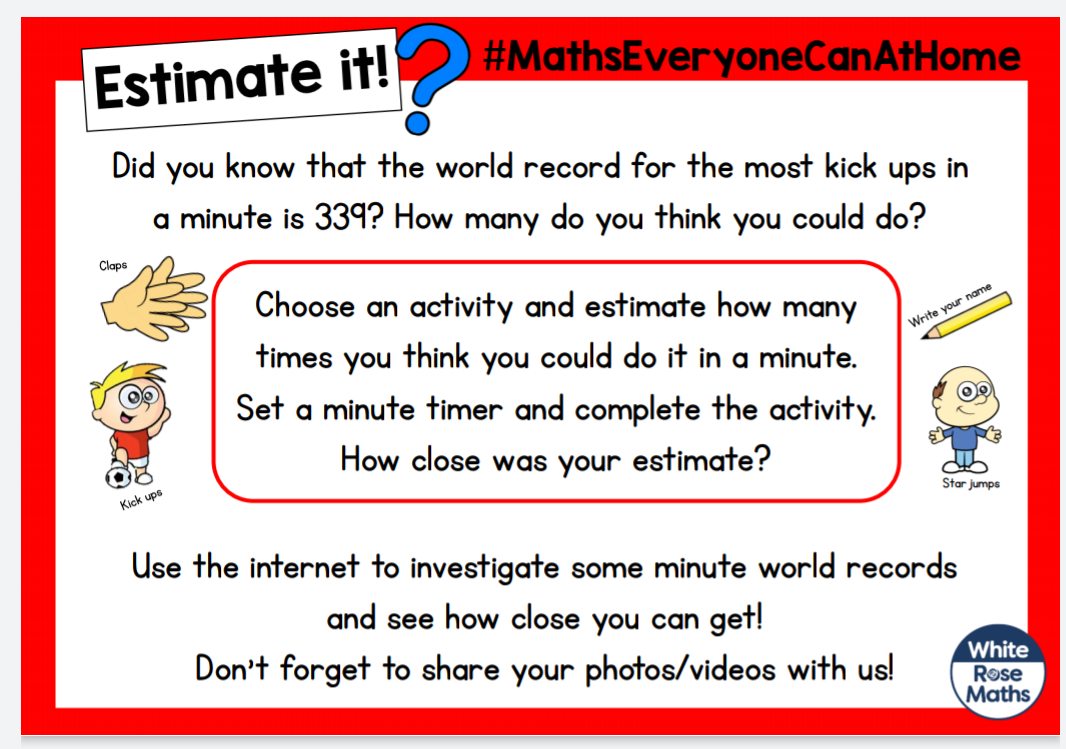
I had a go at this challenge myself. I really wanted to be the World Record Holder….
I predicted that I could eat 40 pieces of sweetcorn in one minute using a cocktail stick! Here’s what happened…Did I break the world record?
Shockingly, after the event, I checked the Guinness World Record – it was 80 in one minute! WOW, that’s impressive, I’m off to practise!
Good luck with the challenge and please share your attempts if you can on our Facebook page!
_____________________________________________________________
Thursday 23rd April 2020
Good morning to you all! Today there is a forecast of sunshine for Year 5!
I have a little challenge for you all… can you help add a little sunshine into someone else’s day?
How about..
Making some time to play with a younger sibling and letting them decide what to play?
Created some art for a loved one who you would like to make smile?
Could you phone a friend or relative for a catch up?
Maybe it would be nice to treat your parents to a ‘quiet’ hour in the house?
Could you offer to help with something at home?
There are so many things YOU could do to help make someone else’s day just a little bit sunnier!

English task:
You’ve been busy preparing your setting and character descriptions as well as your conversations between the old man and you over the last 3 days! It’s now time to put those ideas together into a opening chapter/paragraph of your own mystery story! You will have both Thursday and Friday to do this activity, so please take your time and enjoy the magic of writing.
You can begin your story by…
Action – a character does something exciting to begin the story and grip the reader
Description – Describe either the setting or a character ready to inform and intrigue the reader about them
Dialogue – This is a conversation between characters. All conversation must advance the story and have a purpose to what is being said.
Here are some examples of how you could start your story using action, description or dialogue…
The ancient door creaked open and the old professor stared hard in my direction. Had
he seen me hunched amongst the elders? I held my breathe and waited.

Peering between the overgrown leaves, I noticed that each individual stone of the ancient
cottage told its own story.

"Come, follow me.. Don't make a sound, I think he is still sleeping!"
You have two days to perfect your paragraph so please don’t rush. Keep re-reading and editing your ideas to make your story as intriguing, exciting, mysterious and descriptive as you possibly can.
Please feel free to share your work on our Facebook page, if you would like to, as it would be amazing to hear or see some of your awesome writing from the week!
Maths task:
Green/Yellow groups:
It’s time for lesson 4 – ‘adding decimals crossing the whole’ visit this page and watch the video.
Thursday Task – Yellow and Green
Thursday Answers – Yellow and Green
Red group:
First job this morning is to go back and play a few games of ‘Hit the Button – Make 100 (tens)’ to practise your number bonds to 100 in order to refresh your memory! Then have a go at Red 1 task. The bonds to 100 are set out as bar models. Be careful the answers are on the same PDF!
Once your confident with whole 10’s numbers e.g. 70 + 30 = 100 40+60 = 100
Have a read of this… Red task helper
We can calculate any number bond to 100 through our knowledge of place value.
You will find that the 'tens' numbers will always add to 90.
The 'ones' numbers will always add up to 10.
If you’re ready try Red 2 task and then play the harder game ‘ on ‘Hit the Button – Make 100’ which uses numbers which are not multiples of 10.
Bon Chance la class!
____________________________________________
Wednesday 22nd April 2020
English task:


Imagine you have entered the building. Behind you the door closes gently and you see this man sat in emerald green robes, peering at you over his glasses, the candles flicker and die out. It’s pitch black and he whispers something to you….
What does he say?
What would you say back to the man?
Why did you decide to visit him?
What does he want from you?
Act out/and then write a conversation between you and the mysterious man using speech bubbles.
It should be laid out a little like this Conversation Speech Bubbles although you can use more than one page if you would like to!
Maths task:
Yellow and Green:
Visit this instructional video in order to learn how to subtract decimals within 1. Click on ‘Lesson 3 – Complements to 1’
PICTURE HERE
If you can, test your skills and play at least 20 minutes of the Number Bonds to 1 game at HIT the BUTTON to practise this skill.
INSTRUCTIONS TO FIND NUMBER BOND GAMES
Below are links to the PDF’s of the task sheets which go alongside the video. They can be printed off, or you can write both the questions and your answers straight into your ‘learning at home’ books, if you do not have a printer.
Task sheet is here… Wednesday Maths Task
Answers are located here… Wednesday Maths Answers
Red:
First, watch this video:
Use Blank 100 squares to colour your own number bonds to 100. Can you try making a bond to 100 which does not include any whole tens? For example 75 + ?? = 100. Use your 100 squares to record your findings.
Then play at least 20 minutes of the Number Bonds to 100 game at HIT the BUTTON. Can you challenge yourself to number bonds which are not whole tens?
INSTRUCTIONS TO FIND NUMBER BOND GAMES
____________________________________________
Tuesday 21st April 2020
English task:

Create a character map for your stories new villain! Draw or stick a picture of him
in the centre of your page (central image) and get mind mapping! Your mind map
should use 4 main branches - physical appearance, personality traits, likes and
dislikes. Then you need to add your own ideas (detailed branches)
Consider things such as:
Who is he?
What is his link to the building?
Why is he raising his finger?
How old is he?
What makes him a villain?
How does he talk?
How does he react when angry?
Does he have any secrets?
What are his most prominent physical features?
The video below will help you with making a superb colourful mind map of your own!
Maths task:
Visit this instructional video in order to learn how to subtract decimals within 1. Click on ‘Lesson 2 – Subtracting decimals within 1’

Below are links to the PDF’s of the task sheets which go alongside the video. They can be printed off, or you can write both the questions and your answers straight into your ‘learning at home’ books, if you do not have a printer. I would like all groups (red, yellow and green) to try today’s task and do your best to get to the end of the tasks. It shouldn’t take more than an hour though, so just do your best!
Task sheet is here… Tuesday Maths Task
Answers are located here… Tuesday Maths Answers
Additional support for Question 7 – Trial and Error method
_________________________________________________________________________________
Monday 20th April 2020

Welcome back to you, our wonderful Year 5 ‘home schoolers!’
We continue to miss you all and can’t wait to find out about all the wonderful things you have been up to during your time away from school!
We hope that you have enjoyed a sunshine-filled Easter weekend, either in the garden or during your daily exercise. If you were lucky enough to receive any chocolate eggs, we hope they tasted delicious!
Did you manage to see our Facebook video? Hopefully it kept you all smiling! Who did you manage to spot in the video? Did you catch a glimpse of Mr Donnelly using a wig to disguise his ‘lockdown’ haircut? Maybe you spotted a snippet of Mrs Griffiths with her gorgeous puppy, Bobby? Or did you manage to track a terrific TA tangoing or rocking in their front room?
Just like before, their will be a English and maths task set each day for you to complete. Times tables, spelling and reading should continue as before and we will be adding some extra enrichment activity ideas for you to enjoy, should you wish to enhance your learning!
English task:
This week we are going to build an amazing first chapter to your very own story. All great stories have exceptional openings. You can begin a story with either action, dialogue or description. We are going to practise each of these skills so you have lots of elements (jigsaw pieces) that you can arrange to create your own magical opening. (a whole jigsaw) Today’s piece will be the description of the setting which will feature in your own adventure/mystery story.
Look at the picture below.
Imagine you have just discovered this building.

Consider these three questions and record your ideas in your ‘learning at home’ book… You could make notes first and then have a go at writing some sentences which describe the setting written as ‘you’, the main character of your story. Keep the story in first person ‘I’ and choose a tense (past, present)
- What is inside?
I imagined it’s magical inside, much bigger than it seems on the outside. Perhaps lit by candles, a strange mix of broken instruments are sat on a large wooden table in the centre of the shed, it is full of cobwebs and extremely dusty. A man lives inside, alone, and he has a dark-secret that he is hiding from the rest of the Kingdom.
2. What does the outside of the Shed look like?
ancient bricks, overgrown leaves, elder trees, stone lion staring, battered-oak door, single candlelight flickers, smoking chimney stack, unused and derelict, looks like a miniature chapel, engraved bench with message for a loved one, no doorbell, knocker or handle.
You could use a slow reveal of details here. Gradually zoom in from larger objects to the smaller ones. Be creative in your language use, draft a few ideas so that they can improved. Adjectives are great for this stage. Don’t be afraid to use metaphors, similes and expanded noun phrases to describe what you can see in the picture. You can add your own ideas even if some things are not shown in the picture. Read my example below to see how my initial notes and ideas became a final paragraph.
3. Where is this building?
In a woodland hidden by lots of large elder trees. There is no pathway leading to the building. It is in a Kingdom called Beyondia which is set in Middle England. You cannot see the building from the nearest track.
Putting it all together to form a setting description…
Here is my example of the opening description of the ‘cottage’ or ‘shed’ in my first chapter. It may still change later on, but its mysterious and describes the setting – which is the main aim of today’s task.
Prologue:
Peering between the overgrown leaves, I noticed that each individual stone of the ancient cottage told its own story. A story which had almost certainly been caused by the extreme weathers which hit Beyondia, each and every Winter. Nervously, I peered to the front of the mysterious dwelling, and found a stone lion staring right in my direction. It was said that he was the only one protecting his master and the many treasures that lay inside. Just the sheer presence of this lion had caused me to reconsider my decision to wander through the rows of elders that hide the cottage deep inside Corden Cut Woods. But it was certainly to late to turn back now. Suddenly, my eyes were drawn to a single flicker of candle light which escaped through the cracks in the battered-oak door. The brightness inside the dwelling turned into darkness. I nervously shuffled my feet forward in order to take a peak inside. It was at that moment that a single, slanted and slightly-sunken eye appeared out of nowhere and the lion began to roar…
Please feel free to share your descriptions to our Facebook page; it would be great to read some of your ideas! Either a photo or you could read them out for us to listen to!
Maths task:
We are going to try some new learning this week – adding and subtracting decimals!
Visit this instructional video in order to learn how we can add decimal numbers using some different visual methods. Your knowledge of place value must be very accurate to complete this weeks learning and you must remember to line up your decimals points when using the formal column method.
On the main page watch the video for Lesson 1 – Monday 20th April – Adding decimals within 1. It should like like the picture below. You will need to click the link above to find the page – unfortunately it can’t be embedded to run from this blog page.

Below are links to the PDF’s of the task sheets which go alongside the video. They can be printed off, or you can write both the questions and your answers straight into your ‘learning at home’ books, if you do not have a printer. I would like all groups (red, yellow and green) to try today’s task and do your best to get to the end of the tasks. It shouldn’t take more than an hour though, so just do your best!
Good luck, Year 5!
_____________________________________________________________________________
Friday 3rd April 2020
A great BIG thank you to everyone who has shared their dream jar poem on our Facebook page. It’s so lovely to see your wonderful ideas and some familiar faces!

LS- I love your dream jar, so creative putting the poem inside the jar and beautifully presented writing! I just hope that’s an LED and not a real candle! 🤣 Top job! 🕯️

EL – Exceptional poetry and a really confident performance- that said, I would expect nothing else from you! Well done superstar! 👍

OB – A delightful poem with so many creative ideas! Well done! 💭

HS – Great to see you working hard off the pitch! ⚽😀 I wonder how the final publish will be laid out?

PS – Are you sure you’re a Year 5!?✍️That is simply superb and I love the way you’ve really thought about such beautiful little details to describe the things in your poem!

SH – I really enjoyed your poetry performance! I never knew the BFG was such a great historian! 📜Great work!

DL – You’ve included so many creative ideas, really ‘stretching’ each sentence to add details, excellent work! 🖊️

IF – I can see that you’ve put lots of effort into your poetry. Great job! 🖋️ #loveroalddahl2

AH- that’s a beautiful dream jar! Well done on creating a descriptive poem using lots of figurative language! I hope you enjoyed writing it! 🌊

LG – Super presentation, you look very proud, and so you should be! 🏆

IB – What a super effort! I hope you enjoyed writing your poetry. It’s great to be able to use imagination to write sometimes, isn’t it? 💭
Sending virtual high fives to you all! 🖐️
We’ll keep our eyes peeled for more poetry appearing over the weekend on the Facebook page! 🌞
Happy Friday! Firstly, a little message from Mrs Burns…

It’s our last day of home school before our Easter Break! Happy Easter Everyone!

It’s been fun beginning our new ‘home school’ journey and I hope you’ve enjoyed completing all of your activities!
Please continue with reading stars reads, times tables and spelling tasks. There will however be no new English or maths tasks set via the blog now until Monday 20th April 2020.
Stay safe, keep busy and be kind to everyone.
All of the staff can’t wait to see you all again in the near future! A big high five and a wave is sent digitally to you all!
Love Mr Donnelly 🧔🏻, Mrs Griffiths, Mrs Burns, Mrs Shepherd, Mr Sharpe, Mrs Freeman and Ms. Wall.
Better have one last ‘dad’ joke of the term:
Two bottles of sauce are running down the road. The brown one turns to the red one and says: ketchup!
English task:
Today’s job will be to neatly write up each of your poetry lines into a final published poem. You may want to add a border, picture or present it inside a real ‘Dream Jar’ that you could make with any leftover jars you have at home. You could even present it using a computer and add your own clipart. Perhaps you could read it out loud and video yourself performing your own poetry? Please share any of these poems to our Facebook page if you can! We’d love to see them as it’s very unusual for the teachers not being able to enjoy your amazing work!
Maths:
Complete the task for maths based upon your knowledge of square and cubed numbers. Be careful as the answers are on the second page of the PDF document!
_________________________________________________________________
Thursday 2nd April 2020
Thursday is here! The sun has been shining and we hope you are all keeping safe. I wonder if anyone had any April fools played on them yesterday? Or maybe you played a cheeky trick on someone you know! You could tell us about it in your ‘learning at home’ book.
A joke for today…
Well done if you were ‘strong’ enough to solve yesterday’s riddle! The answer to the riddle was Saturday and Sunday because all the rest are ‘weak’ days!
This next joke is bad and I’m a little bit sorry for having to share it…
Which object is the king of the classroom?
The rulers!
……….I love rulers….
English task:
Could you extend 4 more of your original ideas? You should then have 12 lines for your final poem by the end of today. This will form 3, 4 line stanzas (verses) of your poem.
Friday’s job will be to neatly write up each of your poetry lines into a final published poem. You may want to add a border, picture or present it inside a real ‘Dream Jar’ that you could make with any leftover jars you have at home. You could even present it using a computer and add your own clipart. Perhaps you could read it out loud and video yourself performing your own poetry? Please share any of these poems to our Facebook page if you can! We’d love to see them!
Maths task:
We have previously investigated how to calculate square numbers. Square numbers are created when you multiple together the same number twice e.g. 1×1=1 2×2=4 3×3=9 4×4=16 These can be represented as ‘five squared’ or 5² which means 5×5 so the answer is 25.
Today we are asking you to investigate another special type of number…..cubed numbers. These can be used to find the area of 3D shapes such a cubes and cuboids.
A ‘cubed’ is represented by a little 3 floating in the air like this…..5³ this one means ‘5 cubed’ or 5x5x5. This can be calculated by solving 5×5 and then multiplying it by 5 again. In this case I would work out…
Step 1: 5×5 = 25 Step 2: 25×5= 125 so 5³ = 125

Your challenge is to calculate the first 10 cubed numbers and present your results in a table like this one… I’ve completed two for you!
x³ |
Number Sentence |
Answer |
1³ |
1x1x1 |
1 |
|
|
|
|
|
|
|
|
|
|
|
|
5³ |
5x5x5 |
125 |
|
|
|
|
7³ |
|
|
|
|
|
|
|
|
9x9x9 |
|
|
|
|
|
You will need to use both times tables knowledge and a written method (practised last week) to solve each one.
Best of luck, team 5! Help and answers are below.
There is a help video here but it does give you the first five answers, so don’t watch unless you are really stuck!
___________________________________________________________________________________
Wednesday 1st April 2020
Good morning Year 5 Home School! Yesterday I went on a cosmic yoga bear hunt with Ava and it’s safe to say I’m NEVER going on a bear hunt again! Ouch! It’s not good when your 2 and half year old says: “Come on Daddy, you’ve got to be faster at getting up!” 🙂
TT Rockstars Update
A busy meet up yesterday with MW, KF, JG, PS and IF joining me online @3pm from Juniper and LG, CL and IF from Sycamore. Well done to IF, who managed to beat the teacher in one round! A virtual house point will be sent down your computer to you! If you fancy the beat the teacher challenge, join me tomorrow at 3pm!
A joke for today…
Well done if you ‘cracked’ yesterday’s riddle! It was of course, an egg!
Another riddle for today…
Q: What are the strongest days of the week?
You can find out the answer tomorrow!
English task:
Repeat yesterday’s task for 4 more of your ideas. You should have 8 completed lines for your poem by the end of today. This will form the first 2 stanzas (verses) of your poem and you can always edit and redraft yesterday’s if you can improve your ideas.
Maths task:
Today’s maths is a task sheet sequence, like in school. Complete the ‘Recalling primes to 20’ task sheet. Everyone must complete both red and yellow tasks. The green challenges are optional if you would like a little more mathematical thinking to do!
All groups Task 1 – Recalling primes to 20
All groups Task 1 – Recalling primes to 20 – ANSWERS
Green challenges!
VENN EVEN AND PRIME VENN GREEN EXTRA CHALLENGE VENN SQUARE AND ODD NUMBERS
Answers VENN green all challenges
________________________________________________
Tuesday 31st March 2020
I hope you are all staying in, staying well and staying busy!
It’s times tables Tuesday! We’ve been rocking TT Rockstars online for over a week now and now it’s time for a written check up – will you be a Rock Hero or a busker who is looking to climb her way to the top?

Print off the following tasks (if you can) and time yourself for 5 minutes on each page. There are 3 pages in each document with answers for you to check your own work.
Then finally calculate your score and ‘ROCK’ rating!
Today’s joke – is not a joke, it’s a riddle! Can you solve it?
What has to be broken before you can use it?
The answer will be given tomorrow on the blog!
English task:
Take 4 of your favourite ideas from yesterday’s plan. Can you ‘stretch’ the sentences and begin to form some poetic ideas for your ‘In the magnificent dream jar I will store…’ poem.
You have several things in your poet’s toolkit that could help you extend your ideas:
Alliteration – the occurrence of the same sound between two closely connected words e.g. jolly giant, chattering children, relentless raindrops
Similes – a figure of speech that compares two different things usually with a ‘as’ or ‘like’ in the middle e.g. ears like saucers, as quiet as a mouse
Metaphor – a figure of speech which makes direct comparison between two things which have something in common but are not exactly alike e.g. her tears were rivers running down her cheeks, He was a mini volcano having a temper tantrum
Personification – attaching a human characteristic to something non-human e.g. the moaning of the trees, the dancing of the waves, the howling of the wind
Onomatopoeia – words that sound like the object or action they are used to describe e.g. boing, jingle and munch
Prepositional phrases – tells us where something happened e.g. under their parents’ bed, beneath the deep blue ocean, inside a child’s imagination.
Adverbials – a word or phrase which expresses time (last week), place (in the garden), or manner (in a strange way)
Expanded noun phrases – used to add a higher level of description than simply using one adjective. You can use commas to separate adjective before a noun or expand after the noun. Listen to the song to get a better idea!
Here is an examples of how to build a sentence from an initial idea into a detailed figurative (poetic) sentence using some of the tools in our writer’s toolkit.
I started with the idea of the sound of tap dancing frogs and added some better vocabulary choices (extend 1), then added a metaphor, preposition and changed the word order (extend 2) and then I added a further preposition and metaphor to complete my ‘stretched idea.’ (extend 3) I could now include this line in my poem!

Maths task:
Use factor bugs to find the factors of the pairs/trios of numbers given below. List any common factors in your book under your factor bugs.
-
There are two versions available – red/yellow…

2. a further green challenge with 3 numbers to find common factors between…

Answers: Common factors answers
____________________________________________________________________________
Monday 30th March 2020
Happy Monday, Year 5! We hope you’ve all had a chance to see the sunshine over the weekend! We’re really missing each and everyone one of you and hope you are keeping busy with exciting activities. We would love for you to ask an adult to share any pictures you may want your teachers to see on our new Park Gate Facebook page so we can see what wonderful things you’ve been up to at home! An email has been sent out to parents to show them how to find this page.
Please don’t forget to sign into bug club, read the books you have been allocated, and answer the comprehension questions by clicking on the aliens green face.
A joke for today:
Mathematicians believe there are three kinds of people in this world: Those who can count and those who can’t.
English task:
We are going to stick with the BFG theme and focus on the BFG’s collection of dreams this week. These dreams are kept in glass jars within The BFG’s magnificent cave.
I would like you to develop your own descriptive poetry skills, using figurative language, to create amazing images in the reader’s mind!
Firstly watch ‘The Magic Box’ by Kit Wright.
Using the format of the poem (and some of the ideas from your Thursday task) describe the sounds or images that the BFG could put inside his ‘magic/dream jars.’
Rather than writing ‘In the magic box, I will put’; we will write… ‘In the magnificent dream jar I will store…’ and add a list of amazing and magical ideas!

Start today with a mind map of some of the ideas you have for unusual things which the BFG could trap inside one of his dream jars. At this stage you won’t have any fully expanded ideas- just a mind map of words of phrases which contain nouns (sounds, objects, emotions) and verbs (actions).
Use a whole page of your ‘learning at home book’ to present this mind map.
You could draw a dream jar in the middle of the page and mind map around it or use our ‘fishbone’ mind mapping method which we used during our Highwayman poetry planning to get your ideas started. Nouns, adjectives, imagery, similes, metaphors, onomatopoeia and alliteration are all excellent additions at this stage! Don’t overly panic, it’s just stage 1 of writing your own delightful poetry!


Maths task:
Factors and primes
A factor is a number that divides into another number exactly, without leaving a remainder.
In class we have used factor bugs to help us discover prime numbers.
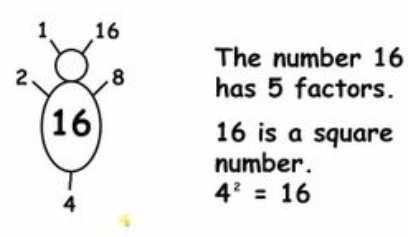
Each bug has two antenna – representing the common factors of ‘1’ and ‘itself.’ We then add pairs of legs to represent each of its other factors.
Any factor bug with legs is called a composite number bug. (We mark these bugs with red spots)
Any factor bug without any legs is called a prime number bug! Prime numbers are special numbers which are only divisible by 1 and themselves. (We mark these bugs with green spots)
Bug which are square numbers (e.g. 1, 4, 9, 16, 25, 36 etc.) have a single factor which is represented as a tail rather than a pair of legs. See example of ’16’ above.
We can use this method to represent factors and test for prime numbers.
For today’s task, we would like you to find out…
- Red -What are the prime and square numbers between 0-20?
- Yellow – What are the prime and square numbers between 0-50?
- Green – What are the prime and square numbers from 0-100?
Please mark them on the hundred square and either show your factor bugs or write a sentence explaining your reasoning why certain numbers, or groups of numbers, can be prime numbers. Complete this neatly in your ‘learning at home’ book as evidence of your learning.

Answers are available here...Prime Numbers to 100

Square number between 1-100 are 1, 4, 9, 16, 25, 36, 49, 64, 81, 100)
___________________________________________________________________________
Friday 27th March 2020
Why, hello there! Your first week at home school is coming to an end and we hope you’ve enjoyed a different style of learning.
Mrs Shepherd has asked me to pass on this message to you all…


Because it’s Friday and that means only one thing—a fun Friday thinking task!
Try to discuss these 3 questions with the people you live with. Maybe around the dinner table or maybe on the sofa with your favourite drink!
Would you rather live on a boat, in a castle or on a cloud and why?
If you could go back in the past and change one thing you did, what would it be and why?
What is the best thing about the people you live with?
A Times Tables Rockstars update…
WOW! It’s a new record! 14 children in Year 5 were all playing yesterday at 3pm and what a match it was! I wonder if we can beat 14 today? There are some great mathmagicians with some super fast response speeds! Great to see you online IF, EL, FW, LFG, DRH, JH, LK, LG (Sycamore) and DFG, DL, JH, MW and HY (Juniper Class!)
A little BFG themed joke for today:
Why was Sophie happy to be living with the BFG?
She always had someone to look up to!
Before I give you today’s learning tasks, I thought I would share a little Ava story – it’s been a while!…
As many of you will know Mr and Mrs Donnelly are expecting a baby in July. On Monday, when Mrs Donnelly went to take a sip of water from her cup, Ava yelled ’NOOOO MUMMY!’ and started to become very distressed. Startled, Mrs Donnelly said “What’s the matter Ava? I’m just having a drink of water.”
Ava replied “Don’t! You’ll get the baby in your tummy wet!”
So cute.
ENGLISH TASK:
Watch this video clip of Sophie talking to the BFG.
You will notice how the BFG uses ‘giant speak.’
Continue the conversation between Sophie and the BFG making sure each character talks as they do in the clip/book.
What would they say next to each other?
Can Sophie convince the BFG to take her back?
Will she convince him he won’t end up living in a zoo so he is safe?
Or will the BFG convince Sophie to keep quiet otherwise their lives are in danger?
You could lay the conversation out as speech bubbles in your ‘learning at home’ book. Like this…BFG Conversation Task
MATHS TASK:
Please continue yesterday’s muddled up multiplication task.
Here are the answers for when your have completed the task.
Red
4 + 18
6 + 5
7 + 2
9 + 13
11+ 1
12 + 22
14 + 8
15 + 10
16 + 17
20 + 3
23 + 21
24 + 19
Yellow
1+22
3+15
4+10
7+16
9+6
12+2
13+5
14+11
17+18
19+20
21+8
23+24
Green
2+5
3+20
4+17
8+9
11+15
13+10
14+24
16+22
18+7
19+12
21+1
23+6
_______________________________________________________________
Thursday 26th March
It’s a long joke of the day today….!
A man sits down in his favourite restaurant and orders his usual; chicken and sweetcorn soup. Instantly, he stops and calls over the waiter. “Waiter, I simply can’t eat this soup.”
The waiter comes over and says “I’m terribly sorry, Sir. Do you not like it? It’s the same one you always order.”
“It’s not that…” replies the man.
Seeing his best waiter a little flustered, the restaurant manager walks over.
“Sir, I’m so sorry. Is it too hot? Too cold?”
The man doesn’t reply and glares right into the eyes of the restaurant manager.
“Right,” says the manager. “Would you like me to fetch the head chef out?”
“If you must,” replies the man.
The chef comes out and looks angrily right at the man. “There is nothing wrong with my soup! Give me the spoon and I’ll eat it myself!” With that, he looks around the table for the spoon. It becomes a little bit awkward and the man simply replies:
“Finally! Two other people have tried but you’ve finally found out the problem!”
Rockstars update:
A great turnout of 11 online at 3pm yesterday for some crunching times tables battles in ‘Arena Mode!’ Great to see LK, IF, CL, DRH, JS and KP online from Sycamore class and JH, HY,KF and RL in Juniper class! Better luck to you all next time! 😉
English task:
For today’s task we would like the quote below to inspire you to think about what it’s like to be the BFG.
"You mean you can hear things I can't hear?" Sophie said.

"You is as deaf as a dumpling compared with me!" cried the BFG. "You is hearing only thumping loud noises with those little earwigs of yours. But I am hearing all the secret whisperings of the world!"

The BFG, p. 43
Imagine you are the BFG: Draw and describe some of the tinniest sounds that you think the BFG may be able to hear. These should be things which would sound silent to you and Sophie but to the BFG they a very much real!
Here are a few ideas to get you started…
The constant chattering of the ants as they carry lime green leaves to their nest.
The delightful singing of the bees as they collect nectar to make their honey.
The bouncing of a grasshopper as it springs rapidly across the sharp blades of grass.
Maths task: Click here for Thursday’s maths task
Complete one coloured section of the fluency task over the next two days. Each group (red, yellow or green) should continue to apply their chosen method of multiplication which is shown in the ‘I can’ statement on the PDF file.
Don’t forget to show your working out in your ‘learning at home’ ’book. I would use a coloured dot to match each question to its answer (rather than cutting everything out) but you can of course cut them out, if you would like to!
Help videos are also available down the page (Tuesday 24/3/2020) for each method. Best of luck, Year 5! You can check your own work with a calculator. Each answer is provided and you should have none left over at the end of the task! Answers will be uploaded tomorrow should you need them.
_____________________________________________________________________
Wednesday 25th March 2020
Bonjour to you all! Day three and TT Rockstars is getting serious! ‘Jay Perez’ caught me cold but don’t worry I soon got my own number pad groove on and took back victory! A big shout out to ‘Emily Jagger’,’ Beatrice Freeman’ and ‘Amelia Brent’ plus others for a great race yesterday at 3pm!
I hope you’ve managed to find the maths help videos that I posted on the blog yesterday! (Apologies for the opening sounds of Ava asking for a shower during the grid method demonstration! There is also a slight hum of gecko lights in the background, but I guess I’m not a YouTuber in a proper sound studio, I’m just a teacher sat in his half spare room/reptile room trying to teach!) Here are the answers for Monday and Tuesday’s maths tasks if you haven’t been able to mark them yourself.

Here’s a joke for today…
My friend thought he was very clever. He told me that onions are the only fruit or vegetable that have the ability to make people cry. I laughed and threw a coconut at his head. Now who’s the clever one?!
Here’s a creative idea for today…
Have you created a rainbow yet for your window? Many children are making rainbows to put up inside their front windows for children who are walking by during their daily exercise. Here is a picture of Ava (and Mrs Donnelly’s) effort using finger painting. How could you create yours?

English task:
Today I would like you to read your description of the BFG outloud to an adult. Can you edit any spelling, punctuation, word choices or add any extra details to improve your 1st draft? Take your time and make this an exceptional piece of writing! Optional extra: A little sketch of the BFG would make a lovely addition to this piece of writing.
Maths task:
Complete the following word problems using your chosen method of multiplication. Remember to use the videos down below (Tuesday 24/3/2020) to help you to secure your methods)
Multiplication worded problems red, yellow and green
These links should read the worded problems to you…
Red audio…
Yellow/green audio…
Be sure to show your working in your learning at home book please. ________________________________________________________________________________
Tuesday 24th March 2020
Good morning, Year 5! Day 2 of home school is here and it’s time for a update.
Thank you to those who joined me, ‘Dustin Blowers’ for a Rockstars session at 3pm yesterday. Well done to ‘Lilymay Cherry’ who put in an incredible performance to show me just how rusty my keyboard skills were! At least I got my own back later on with a narrow victory! Let’s see how many players we can get online tomorrow!


A joke for the day:
Yesterday I wrote a song about tortillas. Well actually, it’s more of a rap.
English task:
Today’s English task is to use figurative language to write a descriptive paragraph about Roald Dahl’s fantasticcharacter, the BFG.
Here are some examples of the types of figurative language which you could include in your paragraph:
Metaphors—His ears were enormous spaceships which orbited his head.
Similes— This was followed by an arm: an arm that was as thick as a tree trunk.
Personification— As he spoke, the wrinkles on his face danced like the waves of an ancient ocean.
Alliteration — Every night his terrific trumpet delivered delightful dreams through every child’s window.
You should also include some literal descriptive sentences such as: Although he was almost human, Sophie was sure that he was in fact not a human. He was something much larger, in fact he was something of a giant.
When he spoke, he spoke in a kind of English, a kind of English which was laced with mixed up riddles.
Here is a picture to help you describe the BFG.

Maths task
Complete the next 5 multiplication questions using grid, expanded or compact method. Check your answers with a calculator once you’ve tried your very best! Can you spot any errors?
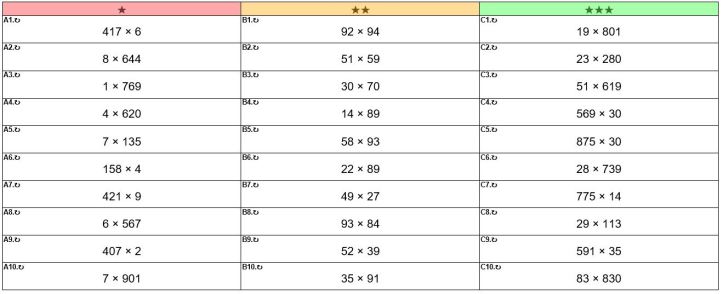
Grid Method – Red help
Expanded Method – Yellow help
Short, compacted – Green help
___________________________________________________________
Monday 23rd March 2020
Reading – Read the biography of Roald Dahl and complete either the * (Red), ** (Yellow) or *** (Green) questions. Please don’t scroll past and use the answers (although we have included these to allow you to learn from them when marking by yourself or with an adult) Approximate timing (45-60 minutes) t2-e-2232-uks2-roald-dahl-differentiated-reading-comprehension-activity-_ver_2
Maths – Complete the first 5 multiplication questions using either the grid method (red), expanded (yellow) or short compacted (green) – Just complete one column and use a calculator to check and tick your own answers. Approximate timing (45-60 minutes)
_______________________________________________________________
Ongoing Learning:
Spellings (Aim for 2 or 3 activities per week) – Pick 1 spelling activity off the spelling menu and complete this activity for this week’s word/s (15 minutes per day)
This week’s spellings are: competition, conscious, convenience, curiosity, definite
Choose from this list…KS2-Spelling-Menu

Here are the other Year 5/6 statutory spellings…
________________________________________
Times Tables (Aim for 4 or 5 sessions per week) other and online maths resources
Times tables and division facts practise Hit the Button – times tables and division facts

Daily 10 maths practise – https://www.topmarks.co.uk/maths-games/daily10
______________________________________________________________________________________________
Personal Reading Time (30 minutes per day) – Continue reading your ERIC/library book each day. Book reviews can still be submitted for raffle tickets (in Sycamore Class) which will be counted up upon our return to school. Don’t forget to keep updating your Reading record as all reads will count towards reading stars rewards!
Books are also available online via Book Bugs (Check your learning at home book or reading record for how to sign in) Your teacher can see the books you have read and how well the questions have been answered!
 ________________________________________
Handwriting (Strengthening Yoga) (a few times per day)
Don’t forget to use your strength poses to complete daily activities. It could be reading, playing a game, singing, anything really that is completed in each of our strengthening poses.
Strong Gorilla, Strong Meerkat, Strong Lion, Strong Lizard, Strong Penguin, Plank, Chair lift.
_______________________________________________________________
Ongoing P.E Ideas
Use ‘5 minute Move’ Kids Workout by Joe Wicks. There are plenty more available on his YouTube channel and you can repeat each video several times throughout the day to keep you moving! Joe will be providing live workouts on his YouTube channel at 9am! Don’t miss it! Yoga is another amazing way to keep active, there are several amazingly enthusiastic yoga videos available for children including this Stars Wars Adventure for you to experience! You can use move the sofa and turn your lounge into a mini dance studio using JustDance to guide you in some new routines!
________________________________________
Project Learning – Optional
We would like you to continue our chemical chaos theme and research one chemical element from the periodic table of elements. Some examples of chemical elements are: gold, oxygen, titanium, helium, hydrogen and silver. You can choose how you present your project learning and you should take several hours on this task.
Consider researching questions such as:
- What does the element look like?
- Where can it be found?
- Does it have any special uses?
- What is the chemical symbol for your chosen element?
- Is it found as a solid, liquid or gas?
- What is the atomic number of this element?
_______________________________________________________________
Other optional Ideas for the week:
- Ask an adult if you can try dissolving some different substances (found in your house) in different solvents. Take photos and describe what you have observed. Can you explain what you found out?
- Download and explore with Scratch programming https://scratch.mit.edu/ Can you build your own ‘Cat and Mouse’ Style Game like we did in class? Perhaps you could instead use sound buttons to create an informative documentary about something you are really interested in?
- Using your library book, make a list of any new vocabulary you encounter and look up its meaning using a dictionary
- Investigate – What makes the perfect paper aeroplane? Try to convince someone of your findings
- Photography challenge – Take a photo of something that is each colour of the rainbow (Red, Orange, Yellow, Green, Blue, Indigo, Violet)
- Art Attack! – Create your very own BFG, Sophie or DreamTree sketch/watercolour


Good morning Year 5! 🙋🏻♂️ This is the start of an exciting new adventure! Welcome to your very own ‘Home School’! 📖 It’s new to us all- but we know you’ll be just great! 👍🏻
Every day this blog page will be updated with one essential English📝 and one essential maths 🎲 task for you to complete.
Spelling, reading 📚 and times tables learning should be completed 3-5 times per week and we have also provided lots of optional activities to keep you busy and having fun.
Your new ‘learning at home’ book is the perfect place to keep a record of all the wonderful learning you have undertaken at home. Maybe, this book could also serve as an amazing opportunity to log your activities, thoughts and feelings 😀😂😴😡 ; acting as your very own daily diary?📒🖌
Remember, learning is not just about tricky maths and impossible grammar rules. It is about enjoying life, trying new things and improving your skills. Don’t forget that baking 🧁, colouring 🖍, board games, kicking a ball ⚽️, online gaming 🎮, dancing 💃🏾 and singing 🎤 are all skills which we need to learn and master! Spend lots of time doing the things you love ❤️, with the people you love 💜.
We will all miss you and very much look forward to seeing 👀 you (and your wonderful learning) when we return back to our amazing school. 🏠
There are 5 rules at home school:
1. keep positive
2. try hard
3. stay safe
4. be kind and respectful
5. have fun
Mr Donnelly 🧔🏻, Mrs Griffiths, Mrs Burns, Mrs Shepherd, Mr Sharpe, Mrs Freeman and Ms. Wall.
Sorry I forgot the 6th rule.....always use a ruler! 📏
 Park Gate Primary School